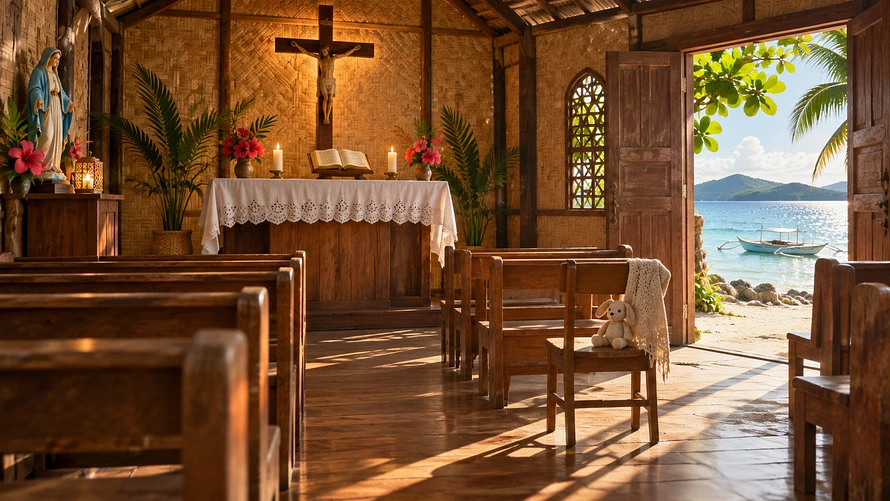
Mark 10:14 NKJV. Please open your own Bible and read Mark 10:13–16 slowly, noticing who moves toward Jesus and who tries to manage the doorway.
Encouragement: Jesus does not treat quiet, small, uncertain people as interruptions. He makes room for them and calls His church to do the same.
Invitation: Save one chair, learn one name, and give one overlooked person your unhurried attention this week.
This scene is illustrative, not a report of a particular child, family, church, or mission event. On a small Philippine island, the Sabbath morning breeze arrived before most of the congregation did. It carried salt from the water, smoke from somebody’s breakfast fire, and the faint opinion of a rooster that believed sunrise required his personal supervision.
The chapel stood a short walk above the shore. Its concrete walls were painted cream, though the sea air had begun adding its own gray decorations near the windows. On the veranda, two young teachers arranged low plastic chairs for the children’s class. Red chairs went in one row, blue chairs in another, and one green chair refused to match anything.
“Put it at the end,” Mara said.
Her cousin Benjie turned the green chair around as though another angle might improve its manners. “It still looks green.”
“That is usually what green chairs do.”
They laughed quietly and kept working. A woven mat went near the front. A jar held pencils sharpened to very different lengths. A paper boat, left from the previous week, rested beside an open Bible. No printed words were visible from where the children would sit; the Bible was simply open, waiting to be read aloud.
Mara counted the chairs. Twelve children usually came. She set out thirteen.
“Who is the extra chair for?” Benjie asked.
Mara looked down the coconut-lined footpath. “Someone who has not decided yet.”
Near the bend stood a boy named Nico. He was new to the barangay and had come with his aunt to the market during the week. A neighbor had invited him to the children’s class, but he had not said yes. He had not said no either. At eight years old, he had already learned a useful adult skill: standing close enough to observe while pretending he was on his way somewhere else.
Nico watched the other children arrive. They greeted one another, compared sandals, and argued cheerfully about whether the paper boat could survive actual water. He stayed near a palm tree and studied the path as though it contained important government documents.
Mara saw him. She did not call his name across the yard. She did not wave both arms and make twelve children turn around. She simply left the green chair empty.
The question beneath this ordinary scene is one many people carry long after childhood: Is there a place for me if I am not sure how to enter?
Christian encouragement for children and families
Mark 10:13–16 gives us a tender and uncomfortable picture. People bring children to Jesus so He can touch them. The disciples rebuke those who come. Perhaps they think they are protecting Jesus’ time. Perhaps they believe more serious matters deserve His attention. Whatever their reasoning, they become guards at a door Jesus intends to keep open.
Jesus is displeased. He tells them to let the little children come and not forbid them. Then He receives the children, embraces them, and blesses them.
Read the complete passage in your own NKJV Bible. Notice that the children do not give speeches. They do not demonstrate advanced understanding. They are brought in dependence, and Jesus welcomes them.
The kingdom of God is received, not achieved.
That truth begins with grace. None of us enters God’s family by being impressive enough. We come because Christ has opened the way. His life reveals the Father’s love. His death carries the guilt of our sin. His resurrection declares that death and evil will not have the final word. We are saved by His mercy, not by our spiritual résumé.
Children often understand dependence more honestly than adults do. They ask for help before checking whether the request will make them look competent. They receive food they did not buy, sleep under roofs they did not build, and trust hands stronger than their own. This does not mean every child is naturally saintly. Anyone who has watched two children negotiate one mango knows the doctrine of human selfishness remains well supported.
But children remind us that life itself is received.
Adults spend years trying to hide this fact. We prefer to appear self-sufficient. We organize, plan, earn, repair, and explain. These are useful abilities, but they cannot reconcile us to God. The gospel asks us to come with empty hands and trust what Jesus has done.
That can feel harder than working for approval. Work gives us something to count. Grace gives us Someone to trust.
The people near the edge
Nico moved from the palm tree to the chapel steps. That was progress, though no one announced it.
The class began with a song. One child sang loudly, one sang in a key known only to migrating birds, and another moved her lips without producing any sound. Mara welcomed everyone and told them they would hear how Jesus received children who were almost kept away.
“Why would anybody stop them?” a girl asked.
Benjie looked at the row of children. “Sometimes people think God only wants the ones who already know what to do.”
Nico could hear from the steps.
Church communities do not usually say, “Only confident people may enter.” We communicate it in smaller ways. We use words newcomers do not understand. We keep conversations inside familiar circles. We assume quiet people prefer to be ignored. We plan every chair for the people already expected.
Children notice these signals quickly. So do widows, newcomers, people with disabilities, tired parents, teenagers who are unsure what they believe, and adults returning after years away. Many stand near the edge, watching to see whether the welcome is real.
Compassionate Christian service begins by noticing without embarrassing.
Jesus saw people others treated as delays. He heard blind beggars when crowds tried to silence them. He spoke with women others avoided. He touched people labeled unclean. He welcomed children when His own disciples tried to improve the guest list.
Following Jesus means letting His attention retrain ours.
This is not a call to perform friendliness. People can feel when welcome is a project designed to make the helper feel noble. Genuine hospitality respects choice. Mara did not drag Nico from the path or demand his story. She made the place visible and left room for him to decide.
Love can be patient at the doorway.
A chair is a small theology
An empty chair can look like wasted space. In the kingdom of God, it can become a promise.
The chair says, “We expected that someone else might come.”
It says, “Your arrival will not inconvenience us.”
It says, “You do not have to take another person’s place to belong.”
Churches express theology through ordinary arrangements. A shaded place for an elderly neighbor says something about dignity. A clear path for a wheelchair says something about the body of Christ. Simple words for a new believer say something about patience. Safe procedures for children say something about protection. A meal with enough for one more says something about grace.
Buildings and programs do not save people. Jesus saves people. Yet our practical choices can either support the truth we preach or quietly contradict it.
If we teach that Christ welcomes sinners but make newcomers feel like trespassers, our chairs are arguing with our sermon.
If we say children matter but give them exhausted leftovers of time, unsafe spaces, or adults who have not prepared, our schedule is speaking louder than our words.
Children’s ministry is not entertainment offered while important worship happens elsewhere. It is discipleship. It is also a trust. Adults who serve children must be accountable, appropriate, and safe. Warmth never replaces wise safeguards. Christian communities should protect children, respect parents and guardians, and respond seriously to any concern.
Jesus’ welcome is tender, never careless.
Receiving the kingdom
Mara opened the Bible and read the passage aloud. She explained that receiving God’s kingdom like a child does not mean refusing to grow in wisdom. Scripture calls believers to mature faith. It means receiving the gift of God with trust rather than pride.
“Can somebody earn a blessing?” Benjie asked.
Several hands rose.
One child said yes because she had swept the floor without being asked.
Another said no because blessings were not wages.
A third said it depended on whether the blessing was dessert.
The class considered this with the seriousness it deserved.
God does care about obedience. Grace does not make our choices unimportant. But obedience is our response to love, not the price of love. We do not persuade Christ to receive us by behaving perfectly. He receives us, forgives us, and begins teaching us how to live.
This protects children from a cruel misunderstanding: that God is pleased only when they never make mistakes. It also protects adults who still carry that fear from childhood.
The Father is not waiting for one wrong move so He can remove your chair.
Sin is serious because it wounds people and separates us from God. Confession matters. Repentance matters. But forgiveness rests on Christ’s faithfulness. When we fall, we return to Him. When we are ashamed, we do not need to hide behind the palm tree forever.
Grace creates courage to come closer.
Sabbath room for people
The class ended before the main worship service. Families began gathering inside the chapel. Someone tested a microphone, producing one loud thump that startled a gecko into reconsidering its location.
Sabbath is a weekly testimony that people are more than their output. For six days we work, solve, carry, sell, teach, fish, cook, repair, and count. On the seventh day, God invites us to rest in His completed care.
Children need this truth. Adults do too.
The world often measures children by grades, speed, behavior, confidence, or future usefulness. The world measures adults by income, efficiency, influence, and visible success. Sabbath interrupts the measuring. It says our deepest identity is received from the Creator and Redeemer.
We gather because God is worthy, not because we completed every task. We rest because His love is sufficient, not because the week behaved politely.
Sabbath can make churches spacious again. There is time to hear the quiet answer. Time to share food. Time to walk with a child instead of rushing ahead. Time to notice the person on the step.
Rest becomes a form of hospitality when it gives another person unhurried attention.
When the green chair moved
Nico waited until the songbooks were carried inside. Then he approached the veranda.
Mara was collecting pencils. She looked up and smiled, but she did not make a speech.
“Is the class finished?” he asked.
“For today.”
He touched the back of the green chair. “Why was this one empty?”
“We thought someone might need it.”
Nico nodded. “It is a strange color.”
“We have noticed.”
He sat down anyway.
They talked for a few minutes. He asked whether the paper boat belonged to anyone. Mara said it belonged to the class and could be tested after lunch if an adult went with them to the water. Benjie found another sheet of paper and showed him how to fold one.
Nothing dramatic happened. Nico did not announce a lifelong commitment. The chapel bell did not ring by itself. A quiet child simply sat in a chair that had been saved for someone who had not decided yet.
That is often how belonging begins.
The church cannot control another person’s response to God. We can prepare the space, speak the truth clearly, pray faithfully, protect what is vulnerable, and welcome without pressure. The Holy Spirit works in hearts with a patience deeper than ours.
Some people come quickly. Others stand near the path for weeks. Love does not need to humiliate hesitation.
Hope for every family
Families are not all alike. Some children live with both parents. Some live with grandparents, aunts, older siblings, foster families, or one tired parent doing the work of several people. Some homes are joyful. Some carry grief no visitor can see.
The church should not use one idealized family picture to make everyone else feel like a damaged exception.
Jesus forms a family of faith where people receive one another in grace. This does not erase the importance of healthy homes. It calls every home and congregation to reflect God’s faithful love.
Parents and guardians need encouragement, not constant comparison. Children need adults who keep promises, apologize when wrong, and show that faith belongs in kitchens, markets, boats, classrooms, and hard conversations—not only inside the chapel.
The resurrection and the Second Coming give this welcome a future. Jesus will return. Those who sleep in Him will rise. The family of God will be gathered from every place. No child of God will remain outside because there was no room.
Until that day, each act of Christian hospitality points ahead. The extra chair, the learned name, the patient answer, the protected child, and the shared meal become small signs of the coming kingdom.
We do not create that kingdom by our kindness. Christ brings it. We simply practice its welcome while we wait for the King.
A practice for today
Read Mark 10:13–16 in your own NKJV Bible. Ask where you see yourself in the scene. Are you bringing someone toward Jesus? Guarding the doorway without realizing it? Standing near the edge? Receiving His blessing with empty hands?
Then choose one concrete action.
Save a chair beside you at church or at a shared meal. Learn the name of a child or newcomer and use it kindly. Explain one unfamiliar practice without making the person feel foolish. Ask a parent or guardian what practical support would help. Give a quiet person room to answer without finishing the sentence for them.
If you serve children, review one safety practice and one lesson before the next gathering. Prepare as though their questions matter, because they do.
Do not turn the action into a photograph or a story about your generosity. Let it remain a simple place where the welcome of Jesus becomes visible.
Prayer
Lord Jesus, thank You for welcoming us when we could not earn a place near You. Forgive us for the times we have guarded doors You meant to keep open. Give us eyes for children, newcomers, quiet neighbors, tired families, and everyone standing near the edge. Teach us to make room without pressure, to protect without controlling, and to speak truth with tenderness. Bless parents, guardians, teachers, and church volunteers with patience and wisdom. Let our Sabbath worship show that people are precious before they are productive. Help us receive Your kingdom with trusting hearts, serve with humility, and wait with hope for Your return and the resurrection. This week, show us whose name to learn, whose story to hear, and where to save one chair. Amen.